More help with self-assessment tax bills
If you haven’t paid what you owe within 30 days of the filing date of your self-assessment return for that year, you’ll be charged a penalty. The good news is that HMRC has relaxed this rule for the 2019/20 tax year. What’s the full story?
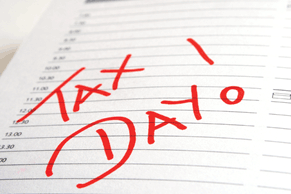
HMRC has today (19 February) announced that self-assessment taxpayers won’t be charged the automatic 5% late payment penalty if they pay what they owe for 2019/20 or set up a payment plan by 1 April 2021.
Normally, a 5% late payment penalty is charged on any unpaid tax that is still outstanding on 3 March following the end of the tax year. But this year, because of the impact of the pandemic, HMRC is giving taxpayers more time to pay or set up a payment plan.
Note that HMRC will stick to the normal rule of charging interest at 2.6% per annum for all self-assessment bills not paid on time.
You can pay your tax bill or set up a monthly payment plan here. You need to do this by midnight on 1 April to prevent being charged a late payment penalty.
Related Topics
-
Give your children a cheap mortgage
Your son is struggling to get on the property ladder and current mortgage interest rates are making it harder. You’re over the inheritance tax (IHT) threshold but you’re reluctant to give him the money because you’ve heard horror stories about others losing half of it in a divorce. Is a family loan the solution for both of you?
-
Loan Charge settlement offers begin to land
HMRC has begun sending formal settlement offers to individuals and employers with outstanding Loan Charge liabilities, alongside detailed new guidance explaining how offers will be calculated and how long recipients have to respond. What’s the full story?
-
The hidden income tax benefit of marriage
You recently got married and a relative joked that you can save lots of money because of the tax breaks for married couples. As a newlywed are you entitled to a reduction in your income tax bill?
 This website uses both its own and third-party cookies to analyze our services and navigation on our website in order to improve its contents (analytical purposes: measure visits and sources of web traffic). The legal basis is the consent of the user, except in the case of basic cookies, which are essential to navigate this website.